LLM Systems 18: Memory Optimization in Distributed Training
1. Memory Consumption for LLM training
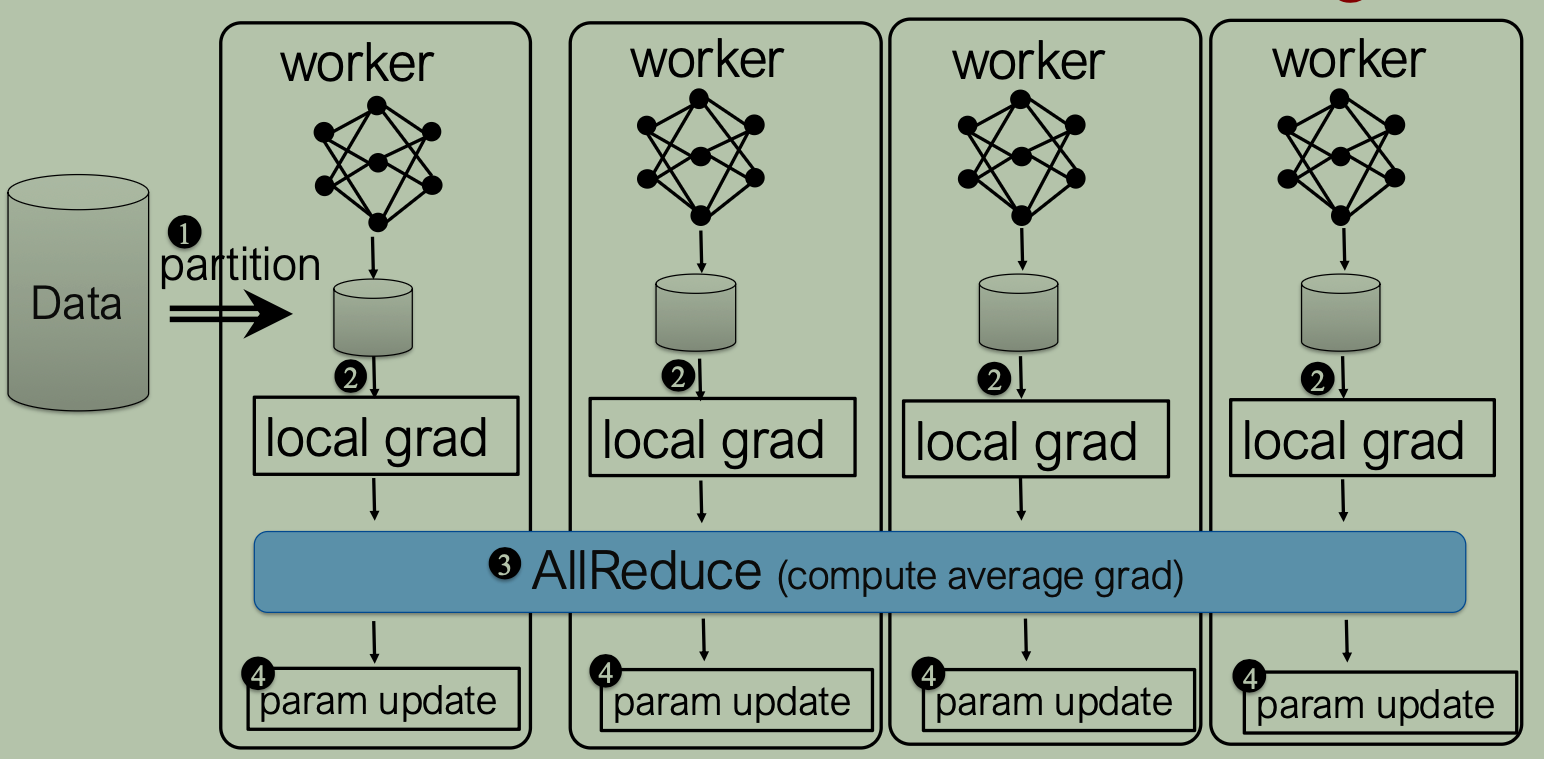
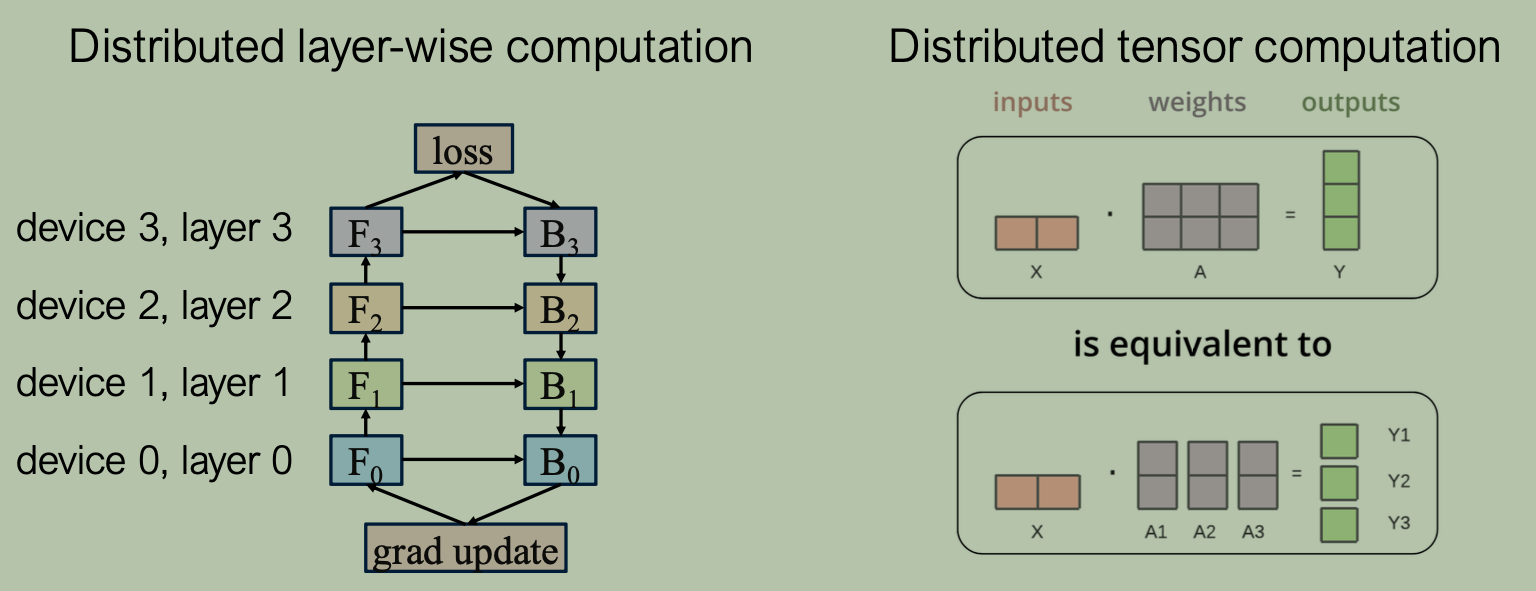
DDP 与 MP 回顾:
- DP
- 优点:
- Good compute/communication efficiency
- 缺点:
- Poor memory efficiency(Every device has one copy of model)
- 优点:
- MP
- 优点:
- Good memory efficiency
- 缺点:
- Poor compute/communication efficiency(5% of peak perf in training 40B model with Megatron)
- 优点:
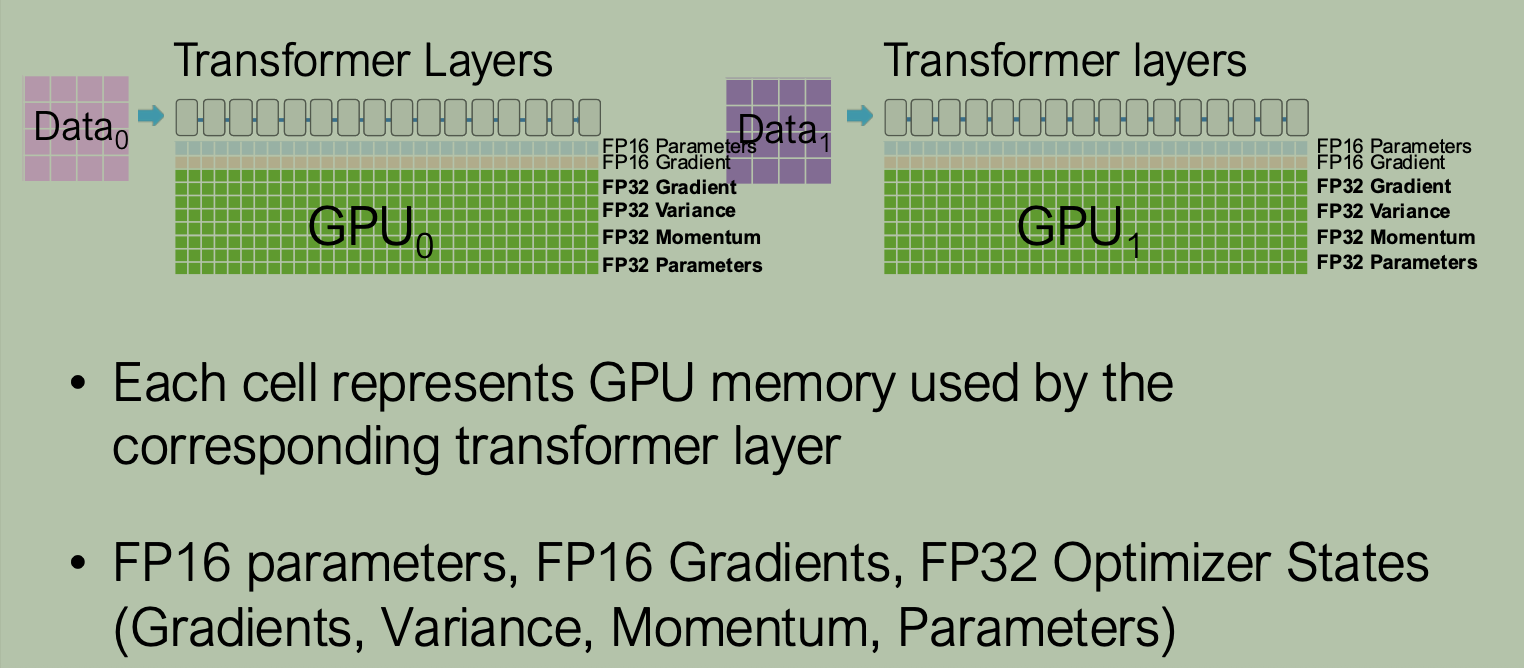
Memory Consumption in DDP (Mixed Precision)
设模型参数量为 \(N\),每个 GPU 需要内存为 \(20N + \text{act}\)
- 模型参数:\(2N\) bytes
- 激活值:\(b \times s \times h \times l\)
- 反向传播梯度:\(2N\) bytes
- 优化器状态(以 Adam 为例):\(N \times 4
\times 4\) ,包括:
- 参数、梯度、动量、方差
- 示意图如下(DP=2):
Other Memory Usages in DDP
- Temporary Buffers:
- Storing intermediate results. Operations such as gradient all-reduce, or gradient norm computation tend to fuse all the gradients into a single flattened buffer before applying the operation in an effort to improve throughput.
- Memory Fragmentation
Common Approaches to Reduce Memory
- ZeRO: Partition Optimizer States, Gradients, Parameters
- Reducing Activation Memory
- Activation Checkpoint, Compression
- CPU Offload
- Memory Efficient Optimizer
- Maintaining coarser-grained statistics of model parameters and gradients
2. Partitioning and reducing the memory for data parallel training
ZeRO - Zero Redundancy Optimizer
- Key idea:
- Eliminating data redundancy in DDP by partitioning the optimizer states (zero-1), gradients (zero-2), parameters (zero-3)
- Widely used for large language model training.
- 7B model memory: 120GB ➔ 30GB (with 4GPUs)
- Implemented in DeepSpeed.
2.1 Partition optimizer states
示意图如下:
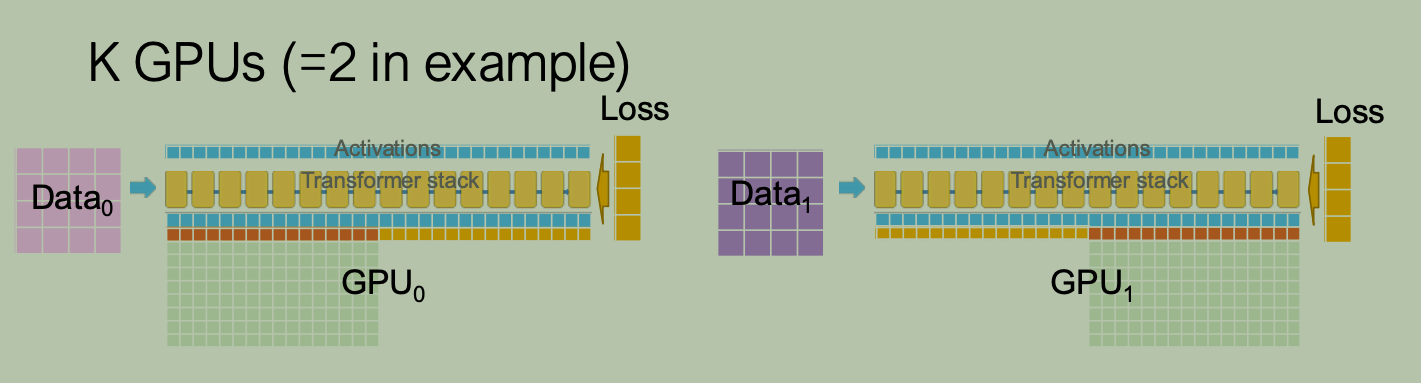
- 切分优化器状态
- 通信过程:
- backward 时 ReduceScatter 获取 Reduce 后梯度分片;
- 更新本地分片参数;
- AllGather 获取全部更新后参数;
2.2 Partition gradients
- Key idea:
- Each GPU compute all parameter gradients for its data partition
- but only stores one partition of gradients instead of all gradients.
- Passing the gradients out of its responsibility to the GPU responsible for those gradients.
- Memory for gradients reduced by K times. (K=# of GPUs)
示意图:
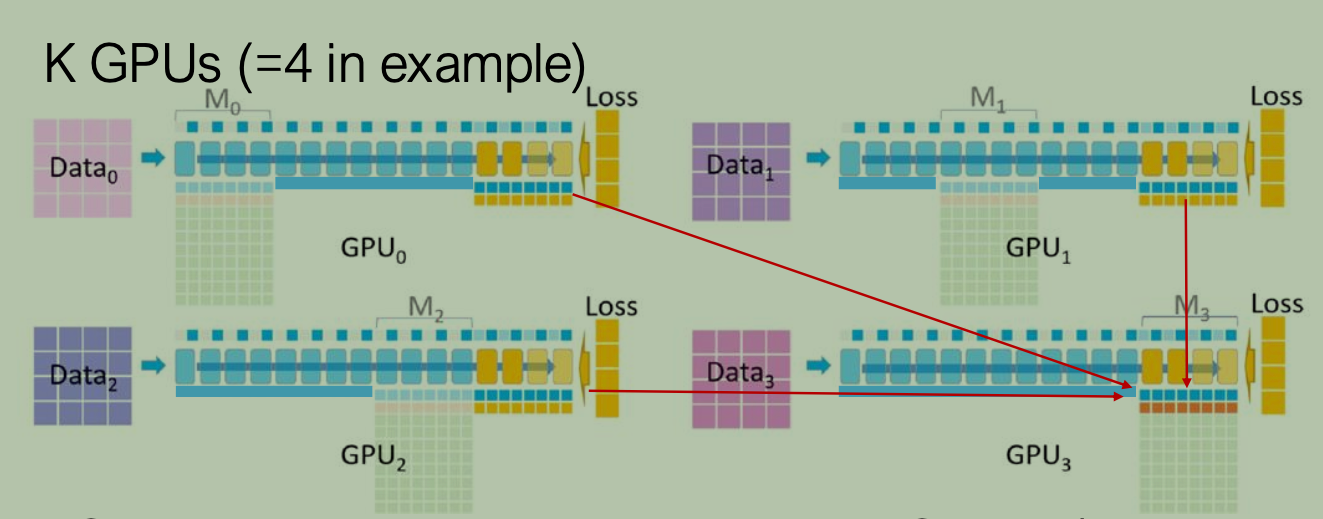
- In backward pass, GPU 0,1,2 hold temporary buffers for the gradients that GPU 3 is responsible for (M3)
- GPU 0,1,2 pass the M3 gradients to GPU 3 (
ncclReduce)- bucket(partition)级别的
ncclReduce,等价于全部 gradients 级别的 ReduceScatter,通信量不变。
- bucket(partition)级别的
- Then GPU0, GPU1, GPU2 delete M3 gradients, GPU 3 keeps M3 gradients.
- Continue backward pass: GPU 0,1,3 hold temporary buffers for the gradients that GPU 2 is responsible for (M2)
- ...
2.3 Partition parameters
示意图:
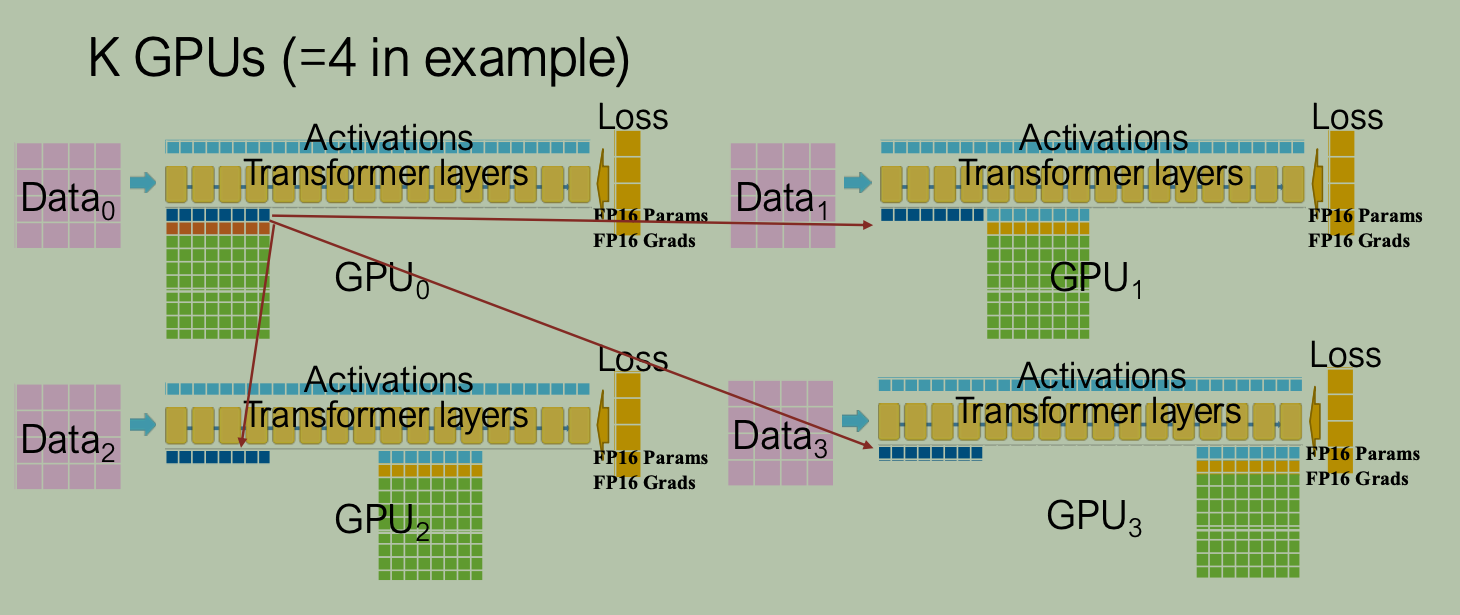
- Partition parameters to K parts
- During forward, GPU0 send first params to other
GPUs(
ncclBroadcast) - compute forward for first part layers
- GPU1,2,3 delete first part parameters, GPU0 still keep first part params
- Continue forward for next part, GPU1 send its params to other
GPUs(
ncclBroadcast), compute forward for second part layers - ...
- During backward, compute backward for 4th part layers. Reduce grads to GPU3 (same as ZeRO stage 2)
- GPU0,1,2 delete 4th part parameters and gradients
- Continue backward, GPU2 broadcast its parameters to GPU0, 1, 3. All GPUs perform backward to calculate local gradients for part 3
- ...
Memory Consumption & Communication Cost for ZeRO
| 阶段 | 显存消耗公式 | 通信开销变化 |
|---|---|---|
| Original DDP | \(4N + MN\) | 基线(\(2N\),ReduceScatter+AllGather 各 \(N\)) |
| ZeRO-1 | \(4N + \frac{MN}{K}\) | 无额外通信总量(与 DDP 相同) |
| ZeRO-2 | \(2N + \frac{(2+M)N}{K}\) | 无额外通信总量(与 DDP 相同) |
| ZeRO-3 | \(\frac{(4+M)N}{K}\) | \(3N\)(fwd/bwd 需要广播模型参数,加上梯度 ReduceScatter,共 \(3N\)) |
3. Other memory optimizations
- Partitioned Activation Checkpointing
- 结合 MP 切分激活值
- Constant Size Buffers (similar to Bucketing in PyTorch DDP)
- Buffer is used in doing all-reduce to improve bandwidth.
- Modern implementations fuses all the parameters into a single buffer.
- ZeRO uses constant size buffers to be more efficient for a large model.
- Memory Defragmentation
- Long-lived memory (Model parameters, Optimizer state): Store together
- Short-lived memory (Discarded activations)
- We can further improve by memory reuse as in LightSeq.
Reduce Communication in ZeRO DDP
- Applying block-wise quantization technique to parameters during
forward (broadcast params). FP16 ➔ INT 8.
- zeropoint quantization
- Apply quantization during backward ReduceScatter, FP16➔ INT8 or INT4
- better partition parameters: maintain a full set of parameters on each node
Combining ZeRO with Pipeline Parallelism and Tensor Parallelism (3D Parallelism)
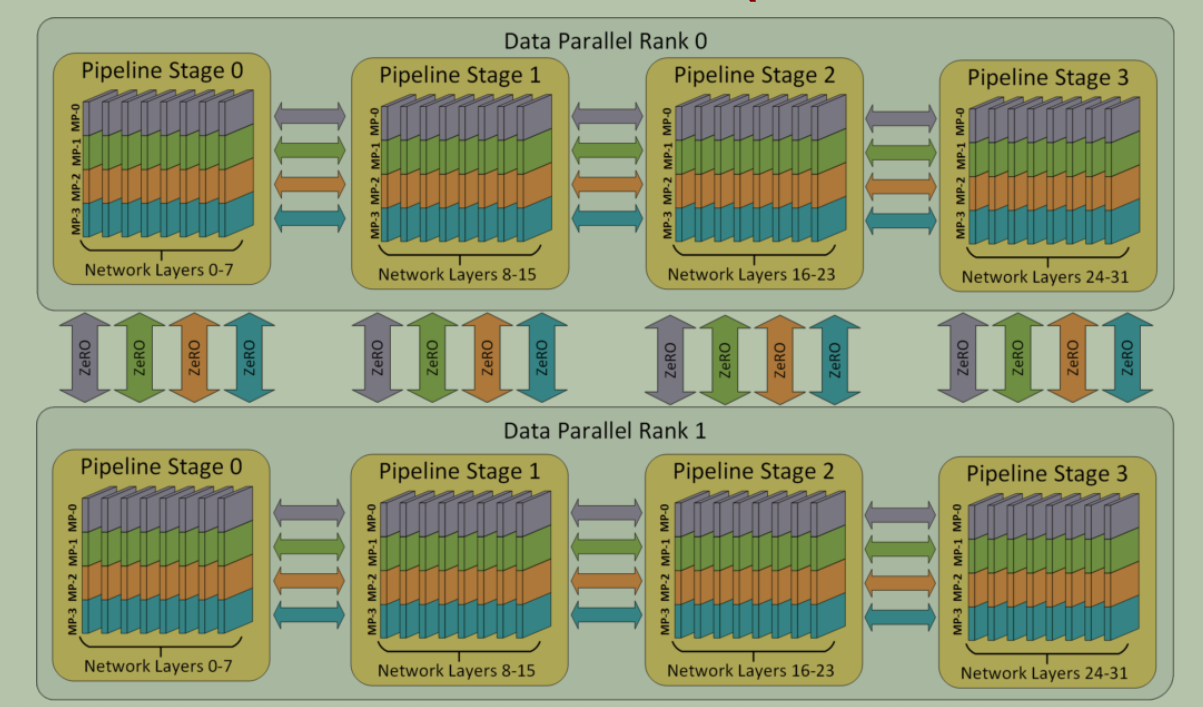
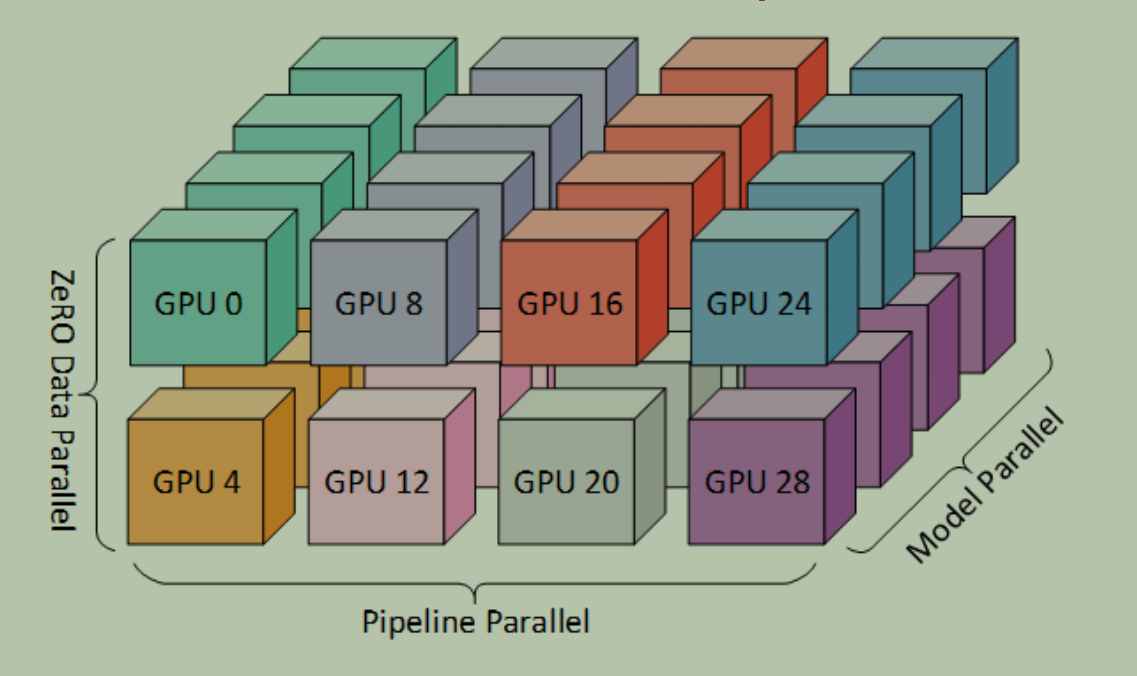
- PP 切分模型不同层
- 单 Node 内进行 TP 切分
- 利用 ZeRO 作用于 DP 维度
- 在不同 DP Rank 中处于相同位置(即处理相同模型层、相同张量分片)的 GPU 之间(上图用带 "ZeRO" 标识的双向箭头连接),建立 ZeRO 优化组,对其对应的优化器状态、梯度及参数进行分摊切片,从而大幅削减 DP 维度的显存冗余。
4. Conclusion
- ZeRO : reducing memory footprint in distributed training
- ➔ enables training significantly larger models
- Key idea: partition optimizer states, gradients, and parameters.
- Pros:
- Lower memory usages significantly.
- Scalable, flexible, easy-to-use.
- Cons:
- Some stages introduce extra communication overhead, depending on infrastructure (PCI-E / NVLink)
LLM Systems 18: Memory Optimization in Distributed Training
https://arcsin2.cloud/posts/2026/10/4185046701/